AI Powered Styling for Your Shoppers : Vue.ai’s Cross Product Recommendations
Author name
Here’s a scenario for you: You’ve found the perfect “match” on Tinder, and want to make an impression on your first date. You want to start off by looking for a shirt and find one that you really like. So you click on it to look at its product detail page.
You start looking at the complete image and love everything that the model’s wearing — from the pants that work so well with that shirt, all the way down to the sneakers that look EXACTLY like the ones you’ve wanted for a while. You have no idea how to look for those sneakers — you don’t even know which brand they belong to! All you have is a vague description of the color and the style.
So you go through the painful process of clicking through innumerable pages and search results… without any luck! So after all that effort all that you’ve done, really, is waste lots of time without even buying that shirt. And don’t even get me started on the sneakers!
If only finding the right look was as easy as swiping right!
I’ve been there. And if your shoppers are anything like me, then you should know that it is extremely frustrating for them to see the products that they want, without being able to buy them.
Introducing Complete the Look By Vue.ai : Cross Product Recommendations for Fashion eCommerce
Here’s the good news. We’ve managed to solve this problem with our Complete the Look module which provides cross product recommendation engine, that can power not just your product detail pages but also your cart and checkout pages.
Complete the Look understands your shoppers’ behavioral patterns and visual affinities to products, and also the rules of fashion, to deliver 1:1 personalization (personalization engine). So your shoppers see curated outfits that are foolproof — in terms of style, color, pattern combinations. Complete the Look acts as your website’s AI-powered styling tool, to showcase curated looks that they’ll love, taking visual merchandising to the next level.
Understanding Shopper Behavior
We’ve noticed that while shoppers are inspired by the different looks offered as a part of the product images, they also want the individual elements making up the look to be “shoppable”.
On further observation, we realized some other aspects that are important to consider when targeting shoppers looking to buy ensembles:
Shoppers like to see accessories and other items of clothing that complement and complete a look, even if it’s not what the model is wearing. This is why cross product recommendations can significantly improve shopper engagement and have a direct impact on the basket size.
A little “visually similar” variety never hurt anybody. It is our understanding that it’s not just an item’s brand or price that shoppers fall in love with. More often than not, it’s also the visual merchandising that draws them. If a product within a particular look is sold out, they’re more likely to continue shopping on your site when you show them something that’s similar to products they like.
When in doubt, offer more choice. Shoppers want to see alternatives to the products showcased in a “look” even when all the original products are still available. This makes it easy for them to shop if something isn’t available in their size or preferred price range.
The versatility of products helps with decision-making. Shoppers like to see how versatile the product they are viewing really is. When you show them a product page that includes pairing suggestions in different colors — they’ll view more, click more, and buy more.
Minimizing navigation is key. While shoppers would like to gather different products within Complete the Look, they would also like to sift through them and add them all to their cart at once. This reduces the risk of the shopper abandoning your site during the course of their purchase journey.
Combining Behavioral Triggers With The Rules Of Fashion
As we developed an understanding of shopper behavior, we combined it with the rules of fashion to zero in on the parameters which would eventually allow our algorithms to curate ensembles without any manual intervention.
Visual affinity: This is a metric that is key to Complete the Look, and replicates the experience of having a personal stylist. We’ve developed a visual grammar by working closely with our in-house fashion and home stylists. This grammar allows the AI to pair the right top with the right bottom-wear, jewelry, and other accessories. This pairing is based on color temperature, the fit, the style, the patterns, the cuts, and much more. We approach it from a style perspective as opposed to just the attributes. So what you get in effect are formal ensembles for work, casual looks, 9 to 9 ensembles, evening wear ensembles and much more which are carefully curated by our artificial intelligence and computer vision engine.
Inter-product Correlation: This provides us with an understanding of how strongly two products are associated — whether they are usually bought together or independent of each other.
Price affinity: This allows us to group products that are termed similar in terms of their prices positioning within their categories. For example, For example, a consumer who purchases expensive items in one category is likely to buy an expensive item in another category as well.
Brand affinity: This considers the shoppers’ preferred brands, and computes the similarity between two brand names to show relevant recommendations.
Different Use Cases For Complete the Look
Use Case I: Getting the Ensemble That Compliments the Product
The shopper can view the curated looks and ensembles on the Product Detail Page (PDP) of each item. If an item is not available, the Vue.ai engine proposes a similar item:
The product recommendation engine also suggest items that are similar to the original products the model is wearing within the display image. So you not only get to shop the look, but also get to see alternatives.
Use Case IV: Get Other Looks
This feature relates to the assumption that users want to see an article in more than one look/styling.
Complete the Look Works, And The Numbers Prove It!
We put the feature to the test, going live with it across some of our fashion, furniture and lifestyle customers. We learned that while it works well on the product pages, it yields incredible results on the cart/checkout page. If we were to look at some of the initial results of how it has performed, we learned that it has led to a 1.5x increase in the average order value (AOV) , with the average order size (AOS) doubled across the board.
Considering that this was a completely new feature for our customers, we’d say these numbers are very encouraging. And with a GMV contribution of 25K USD to the revenue from a single widget, we’re ensuring these retailers are not leaving any money on the table. And with our algorithms only getting smarter, we can safely state that AI curated ensembles are the future of retail.
Superscript
Intelligent document processing
Let’s get real - most of us HATE paperwork. But documents are also the foundation of how our business gets done, from contracts to records to paper applications. Extracting and processing information from these documents involves operationally intensive processes. Or to put it simply, it’s a pain. Let’s get to the numbers involved:
80% of a company’s information resources exist as unstructured data.
9 in 10 employees waste up to 8 hours a week looking for data within documents
Companies spend 15% of their revenue on creating, managing, and distributing paper documents
And the results? Unplanned delays, errors, wasted time and even financial implications when documents are processed poorly.
Convert data from semi-structured and unstructured documents into usable, structured formats.
Enable faster and more accurate processing of documents across use cases (Listed at the end!) with organized data that is optimized for downstream processes.
How It Works
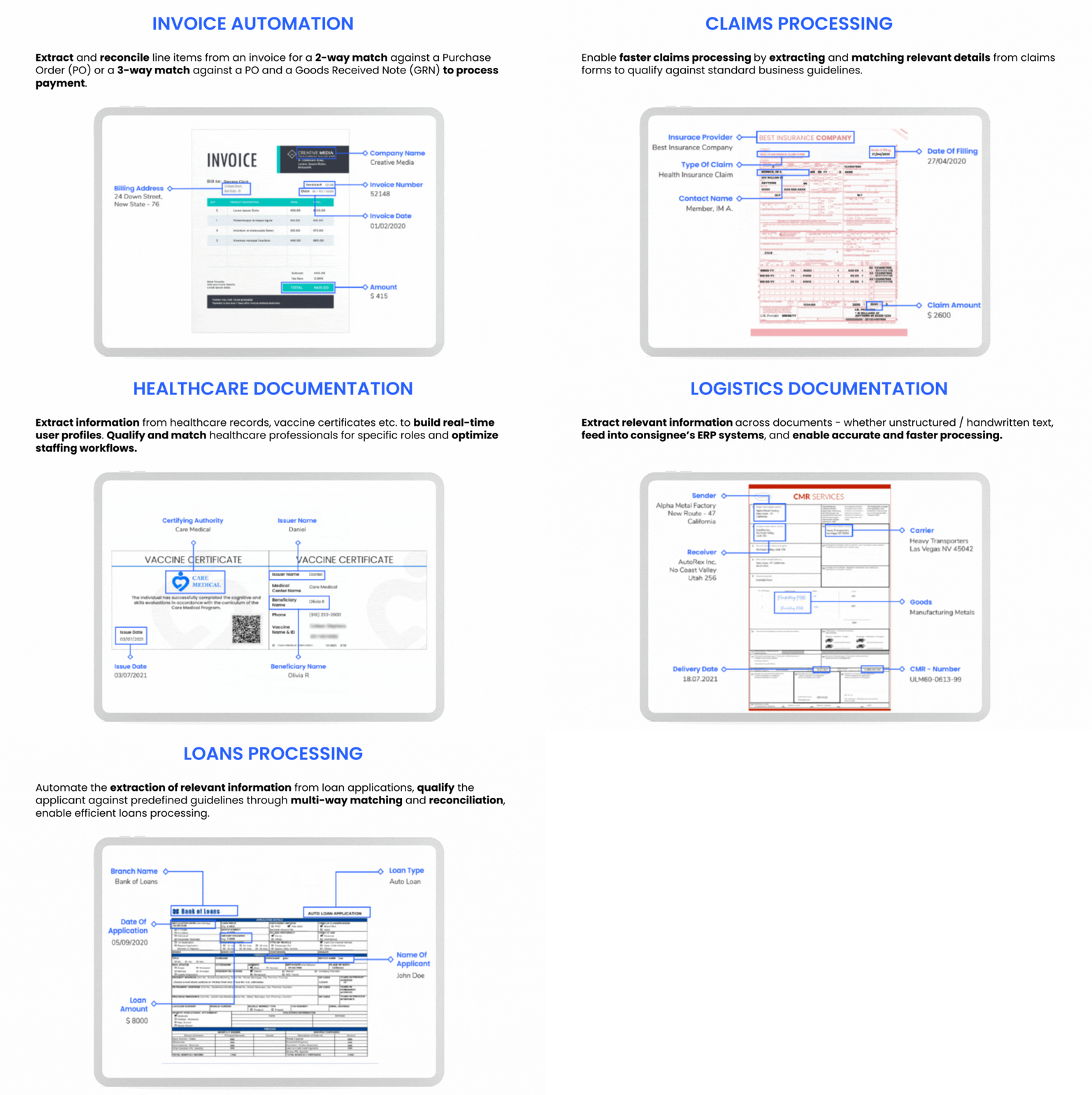
The Blox.ai Intelligent Document Processing solution uses Natural Language Processing (NLP), Computer Vision (CV), Optical Character Recognition (OCR) and machine learning tools to identify, label, and extract relevant data from any input document.
The extracted information is mapped into a structured format while the AI configures a model which can be applied to all similar document types.
The structured data is then matched, qualified, and reconciled against specified guidelines, thresholds, or other documents based on business needs.
The output is pushed to downstream systems automatically.
Blox.ai’s AI-on-AI layer enables real-time selection of the most relevant algorithm for a particular use case from the model library, leading to a more robust solution that is capable of handling diverse scenarios and edge cases.
According to IDC, 43% of knowledge workers say that paper-based workflows make their daily tasks less efficient, costlier, and less productive. With Blox.ai, enterprises have seen:
~ 90% accuracy in extracting key values from documents
85% decrease in time taken to organize data
50% reduction in resource costs
Maximize human potential in your business with Blox.ai
Process any document type through intelligent extraction, multi-way matching, and reconciliation with Blox.Intelligent document processing optimizes your document workflows through a combination of intelligent and programmable automation. Convert data from semi-structured and unstructured documents into usable, structured formats.
Vue.ai’s product recommendation engine tracks website shoppers' behaviour based on their user behaviour. We tracked their historical and live data and based on that we provide product recommendations to them. Every shopper should delight in getting an individualized shopper experience. personalized recommendations that convert 120% better.
Drive growth with personalized product recommendations. Make every customer feel special with 1:1 curated & personalized recommendations that convert 120% better.A personalized experience at every touchpoint. Delight every shopper with truly individualized shopper experiences and grow your revenue.
Style Profiles
Build unique Style Profiles for each shopper based on their likes, affinities, and visual preferences.
Dynamic Personalization
Gauge shopper intent in real time with every click they make, to power relevant product discovery.
Leverage the power of Image Recognition to serve individualized search results to every shopper.
Category
Shopping Cart Abandonment
What is Shopping Cart Abandonment?
Shopping cart abandonment is when a high-intent shopper visits an eCommerce website, adds at least one or more products to the shopping cart, and proceeds to exit the website without completing the purchase. Products that are added to the shopping cart but are not purchased are considered to be “abandoned” by the shopper.
Shopping cart abandonment has absolutely nothing to do with the visibility of the website or the offers run in the advertisements. So this cart abandonment problem cannot be solved by giving away more freebies. This requires a careful analysis of why exactly users are bouncing away from the website despite clearly liking the products.
88% of Web buyers say that they have abandoned an online shopping cart without completing a transaction. – Forrester
How to Calculate the Shopping Cart Abandonment Rate?
Ecommerce cart abandonment rate can be calculated and monitored by ecommerce retailers to understand specific reasons for increase/decrease in revenue. This helps in understanding the percentage of purchase intent showcased by the visitors of the site, who don’t buy even after having items in the cart.
Shopping cart abandonment rate = [ 1- (total no. of completed purchases/number of carts created) ] x 100%
Cart Recovery Rate is calculated by dividing the total number of completed purchases by the number of shopping carts created. Subtract the result from one and then multiply by 100 for the abandonment rate.
Why is Shopping Cart Abandonment a problem for retailers?
With the whole retail apocalypse theory falling flat and the “resurrection” of brick and mortar retail, it’s finally understood and widely accepted that it’s no longer a fight between retail and eCommerce.
Instead, it is all about customer experience at each and every touchpoint, be it online or offline, eCommerce is no longer the juggernaut that retail has to fear.
Instead, while we have seen legacy retailers who ruled the market slip and fall like Sears, Toys R Us after failing to adapt to changing expectations, we have also seen several eCommerce companies fold.
Physical stores and eCommerce websites have their own pros and cons. For instance, eCommerce offers people the convenience of sitting at home and shopping without having to move at all.
However, retail offers a physical experience that eCommerce websites can never replicate. Sephora Studio, Nike’s experience store, Lululemon’s Mindfulosophy are examples of very successful shopping experiences that have won over famously-fickle millennial shoppers.
When you actually talk to consumers, they still want to shop by touching and trying on. They still want to connect, to step into space, and feel something. – Forbes
Ecommerce websites, however, have one unique problem that retailers typically never face. This is called shopping cart abandonment.
Superscript
Block title
This is a block description. To edit, click and type the text or replace it with your own custom content
Package
What’s included
Price
Free
List the features, services, or products included in this package package. Motivate your visitors to choose this option.